Friday, May 25, 2012

Grouch Lager

The perfect summer post-ride beer.

Goal: Northern Ales

Kettle Falls, that is.
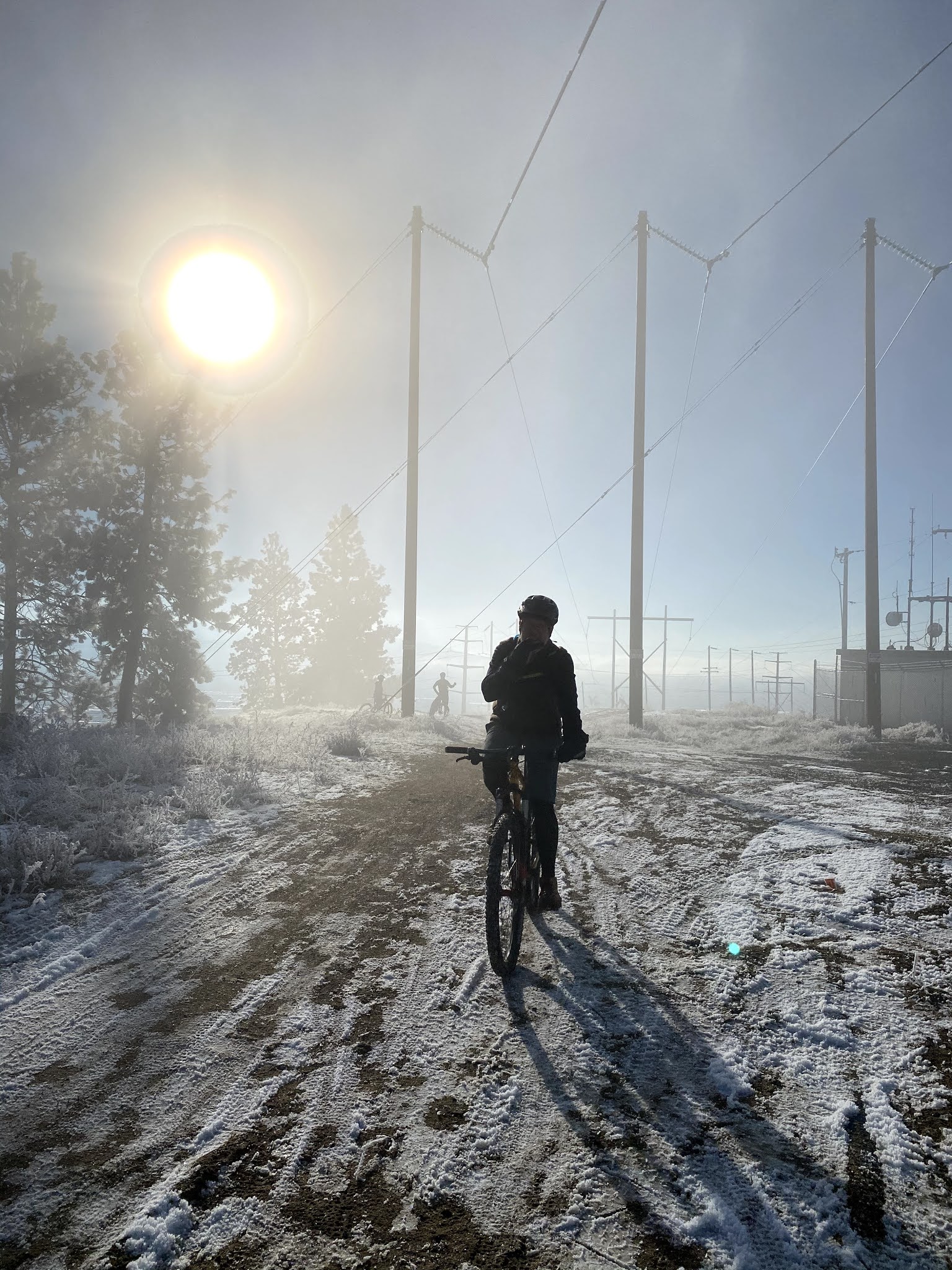
There is solid headwind attempting to thwart my plans. But I know the protected routes.
This little gem of double track connects some county roads in between Loon Lake and Chewelah. And it is wind free.

Thursday, May 24, 2012

Past bikes - bikes #7 and #8

My biggest (and only) bikeless gap was between about 1997 and 1998.

In 1998 I got a fancy job and wanted to commute to work. So I bought a Diamond Back road bike. I remember knowing nothing about a road bike, but I think I felt some brand loyalty to Diamond Back, which I look at now as pretty misguided: both the concept of brand loyalty, and especially to a bike like Diamond Back.

Anyway. It was $400. It sucked. I think I commuted to work on it twice. It was uncomfortable in all ways, had tiny narrow wheels, and I can't remember anything good about it.

Then it sat until I sold it a year or so later when I bought Bike #8: a Giant mountain bike. With shocks.

This bike ruined me for shocks for years and years. What a miserable turd.

It sat for a year or two in my garage as I gained tons of weight and stressed out at work.

By the time I started really riding it, I weighed about 300 pounds. I rode it every morning at 5:30 am for about 6 months. In my memory, it seemed like it was pissing down rain every single morning. I really enjoyed these rides in the dark rain. As sort of miserable as they were, they reminded me why I dug riding bikes and being outside and how stupid my daily life had become: all cooped up in my car ride to my office at work. These early morning rides slowly transformed me into a cyclist. At some point, on one of these early morning rides, I decided to start commuting the 25 or so miles to work so that I could attempt a cross-state tour.

That's what led to Bike #9....

Wednesday, May 23, 2012

Weds night race

We did the 24 hour loop tonight. It was hard. The numbers:
I learned about race signage. There was a place on the race where a sign with 3 arrows pointed one way and a sign with 1 arrow pointed another. I didn't know what it meant so I followed the guy in front of me. As it turns out the 3 arrows is the fast, more technical, way down the hill. The 1 arrow was the slow, windy way down the hill. The guy I followed took the 1-arrow-way. Damn.

About 5 people that I painfully and laboriously passed blew down the fast way. I was only able to catch 3 of them. I found that rather frustrating, but maybe the 1 arrow guy save my bacon by leading me down the slow way.

The new-to-me bike needs a bit of work -- especially on the front shifting and maybe some bar/reach stuff. But generally, it's good.

Stack rank.

This year, the Weds Night Mountain Bike series also includes a run. Liza ran her second race tonight. She's determined not to treat it as a race, but she is clearly having a good time. The course for the runners was not marked as well. They got lost. Here's Liza's stack ranking.

Past bikes - bike #6

Diamond Back Apex: Pretty much your basic 1993 entry-level mountain bike. With funny bull-like curved bars (think bar-ends but with a nice bend). I was a freshman in college and of course I had a new shiny credit card. So I bought my roommate and me brand new mountain bikes. Whooop!

I bought them at North Division Bikes. From Michael. He doesn't remember.

Historical note: there was a bike shop on 2nd and Lincoln called, I think "Bike Works," with a funny looking Bridgestone called an XO-1 as I was hunting for a bike. It was expensive and weird. But I did buy Jobst Brandt's wheel book there, which was mostly beyond me.

Anyway the Apex was my bike all through college. My main memory of this bike was the daily ritual when I got home from school at about 2pm. I'd fire up. Pound a beer or two. Then attempt the straight-down way off the bluff from Brownes Addition to the creek below. About twice a week I'd ride the river trail out to Bowl and Pitcher. Then waiting tables or cooking at about 5PM. Then beers/homework, then bed. Great schedule.
Me. 1994?
On the mighty Apex.
Quite possibly the poorest quality picture I've ever put on this blog.

After college, this bike went with me to Portland, where I lived with friends for about 6 months. Then when we all moved to Seattle, this bike took up a non-insignificant portion of our "living room" in our shared 1 bedroom apartment on Capital Hill. When I eventually moved back to Spokane, this bike came with me and was promptly ripped off from the backyard of a friend's house.

Most memorable wreck: charging around the corner on the rocky/shale-infested/sharp-basalt section of the west approach to the B&P bridge. As I came around the corner, barely in control, a little kid emerged. As much as I wanted to mow him down, my better instincts sent me off the trail: bouncing off the pointy rocks down the side of the hill. I hurt everywhere and I dented the chain stay verily. So I was a bit annoyed when the dad gave me the stink eye as he picked up his son and marched away. That section happens to be a "no bike zone" now. Sorry?

25th & HD

Until 9 am today. Liza made her famous flourless p-butt cookies. Come and eat them before I do.

Sent from my phone.

Monday, May 21, 2012

Review: Panaracer Pasela

This originally appeared in the March issue of Out There Monthly.
I paid for these tires. I'm a big Pasela fan. Especially for 26" wheels.

CYCLISTS THAT BUY TIRES for the first time are often shocked at how expensive bike tires can be. It’s easy to spend $60+ on a single bike tire. The cost of a bike tire can be attributed to how it’s made, what it’s made of, and who makes it.

“Threads per inch” (TPI) is often mentioned when people talk about tires. A higher TPI can suggest a higher quality tire, but in practice, it usually doesn’t.

In bike tire-speak, a “thread” in this context is the fabric under the rubber tread. The fabric threads are layered over each other to form the basic shape of the tire before the rubber layer (tread) is added. Each layer of fabric is a “casing.”

For tires with a single casing, a higher thread count indicates a higher-quality and likely better-performing tire. Although often quoted, TPI is not a very helpful indicator of tire quality since some tire manufacturers advertise the sum of all TPI across multiple layers of casing to inflate their TPI number. So, the first lesson of tire-buying, especially for commuter tires, is to ignore any sales pitch based on TPI.

The casings for the vast majority of tires sold today are made from nylon threads. The casings are woven by machines. On the other hand, super-fancy, high-performance casings are constructed with cotton threads and often hand-woven.

Casings are attached to either wire or Kevlar “beads,” which are the hoops that correspond to the wheel size and hold the tire under the small hook that runs along the inside of the rims on the wheels.
The rubber tread lives on the outside of the casing. Often, a thin layer of puncture-resistant material is sandwiched between the casing and the rubber tread. The sidewalls of the tires are often made of a different rubber compound than the “tread” of the wheel.

The makeup of the tread, sidewalls, and puncture-resistant material determine the three qualities commuters care about in their tires:

• PUNCTURE RESISTANCE: Tire manufacturers have two main weapons against punctures. They add a layer of Kevlar or other puncture-resistant material under the tread, and they can use harder rubber compounds for the tread and sidewalls.

• COMFORT: There are two main variables when it comes to comfy bike tires: volume (tire size) and the amount of stuff between the casing and the road. Big fat tires exemplify why John Dunlop invented the pneumatic tire to replace the wooden or steel bicycle wheel. Puffy tires smooth out the bumps.

In addition, minimizing the number of layers in the tire and using supple rubber compounds for these layers makes for more comfortable tires, since the resulting tire will deform better around bumps and cracks on the road.

• PERFORMANCE: As with all bike-related performance theory, there’s no consensus on whether a rock-hard skinny tire will always out-perform a wider, suppler tire. Most tires are marketed around the concept of “rolling resistance,” where a given tire is rolled on a steel drum that can measure the amount of resistance on the tire. Given this method, it’s no surprise that rock-hard skinny tires have less rolling resistance than higher-volume, more supple-tires. And if the streets of Spokane were paved with smooth stainless steel, there would be no question of which style of tire to ride. But roads are imperfect, bumpy, pot-holey and cracked. In the last few years, enthusiasts and at least one proper study have shown that in real-world conditions higher-volume, supple tires will out-roll their skinny, rock-hard counterparts.

So where does all of this leave the poor cyclist that just wants a stinking commuter tire that is moderately priced, adequately puncture proof, comfortable and fast enough?

The answer: the Panaracer Pasela Tour Guard. It’s about $30.

Buy the fattest width Pasela that you can fit in your bike.

The Pasela is the perfect balance of cost, flat-protection, comfort and performance. It has a fairly neutral tread that rolls fast enough on pavement yet provides just enough bite for non-technical dirt trails and roads. Any local bike shop can order them. And the good ones will have them in stock.